Top 9 Mashvisor Alternatives for Market Research
You are paying for Mashvisor but still running comps in a spreadsheet. Many platforms bundle data you can get elsewhere, leave gaps in off-market coverage, or price tiers for features you will not use. That friction is usually what sends investors hunting for alternatives.
This article lays out what actually matters when comparing tools for market research, then reviews nine options one by one, from Tranchi AI's 44 AI agents to simpler calculators. By the end, you will know which tool fits your research goals and budget, and which one earns the top spot.
What to Look For in Mashvisor Alternatives for Market Research
When evaluating Mashvisor alternatives, focus on data coverage, analytical depth, and actionable outputs that directly support your investment decisions. A strong platform should give you sales and rental comps, neighborhood trends, and core investment metrics in one place. Anything less means juggling spreadsheets and losing time.
The best investment property software combines three things: reliable property data, clear analytics, and outputs you can act on. Before committing to any tool, check how it handles the factors below. Each one affects how much you can trust your deal analysis.
Property data depth. Look for recent sales comps, rental comps, and neighborhood-level trends. Investment metrics such as cap rate, cash flow, and gross rent multiplier should be calculated automatically, not left for you to build by hand. A platform that skips these forces manual work on every deal.
Data accuracy and update frequency. Stale data leads to bad offers. Ask how often records refresh, whether rental estimates reflect current listings, and where the underlying data comes from. A real estate data provider that updates monthly will serve long-term buy-and-hold research better than one refreshed annually, though fast-moving markets may need weekly or daily updates.
Market coverage. Confirm the tool covers your target neighborhoods, not just major metros. If you invest in secondary or tertiary markets, thin coverage can make comparative market analysis unreliable. Test a few of your actual target ZIP codes before paying for anything.
Integration and workflow fit. Tools that connect with MLS feeds, public records, or your existing spreadsheets reduce duplicate entry. Ease of use matters too: a clean interface with saved searches and export options speeds up rental property analysis across many listings.
Specialization. Some platforms lean toward certain property types or strategies. Short-term rental tools emphasize Airbnb data, occupancy rate trends, and seasonal revenue patterns. Fix-and-flip focused tools prioritize rehab estimates and resale comps. Align the tool's strengths with your investment approach instead of paying for features you will never use.
Use this checklist when comparing options:
- Sales and rental comps with visible source and date
- Neighborhood analysis, including trend charts and heatmap views
- Built-in metrics: cap rate, cash flow, ROI, and an investment score
- Clear update schedule and stated data sources
- Coverage of your specific target markets and property types
- Exports, saved searches, and integration with your existing tools
Finally, match the tool to your strategy. A rental income estimator built for long-term leases may misjudge short-term rental potential, and a flip-focused platform may not track occupancy trends well. Research suggests investors get the most value when the platform's core strength mirrors how they actually buy, hold, or sell property.
1. Tranchi AI - Best Overall

Tranchi AI stands out as a comprehensive AI-powered platform that automates deal sourcing, underwriting, and funding, making it a top choice for investors seeking end-to-end support. Rather than stopping at property analytics, it moves into the acquisition workflow itself.
The platform runs on 44 different AI agents that handle 95% of real estate work, from scanning probate court filings and auction websites to underwriting and funding. That scope separates it from a standard property analytics platform focused on market data alone.
It suits both beginners and experienced investors, with a 5.0 rating and 2,742+ users generating an extra $20K/mo on average. A 90-Day Money Back Guarantee and 1-on-1 coaching with the 3 Tranchi Founders round out the offer.
44 AI Agents for Deal Sourcing, Underwriting, and Funding
Tranchi AI's platform comprises 44 specialized AI agents that automate every stage of the investment process, from finding hidden deals to securing funding. Each agent covers a defined task, so the workflow runs as one connected system instead of scattered tools.
The Off-Market Deal Scanner works through proprietary workflows that scan millions of probate court filings, auction websites, and government websites. Related agents include a Probate Opportunity Scraper, County Foreclosure Monitoring, and a Tax Deed Opportunity Scanner, which together surface leads before they reach public listing sites.
On the execution side, Execution Agents handle seller outreach automation and AI-assisted offer negotiation. The platform also includes Acquisition Bots, Auto Offers, and Automated Term Sheet Generation, so the path from lead to signed terms stays inside one platform.
For numbers work, the AI Underwriting Engine supports all deal types with unlimited analysis, alongside Rent-to-Price Ratio Detection and Capital Stack Structuring. The Automated Funding System connects with hard money lenders and private lenders, while the Transaction Automation Layer manages paperwork through a Transaction Coordinator Bot.
Ongoing performance is covered by the Income Engine, plus a Loan Officer Bot and a Tranchi AI Chatbot. Tenant and buyer placement, management placement, and a cash buyers network extend support past the closing table.
Because the agents share the workload, users can run their investing in 1-2 hours per day. A 20-Hour Course covers Contract Flipping, BRRRR, Turnkey Rentals and more, and custom AI agents are available. Pricing is available via sales, and every plan carries a 90-Day Money Back Guarantee.
2. DealCheck
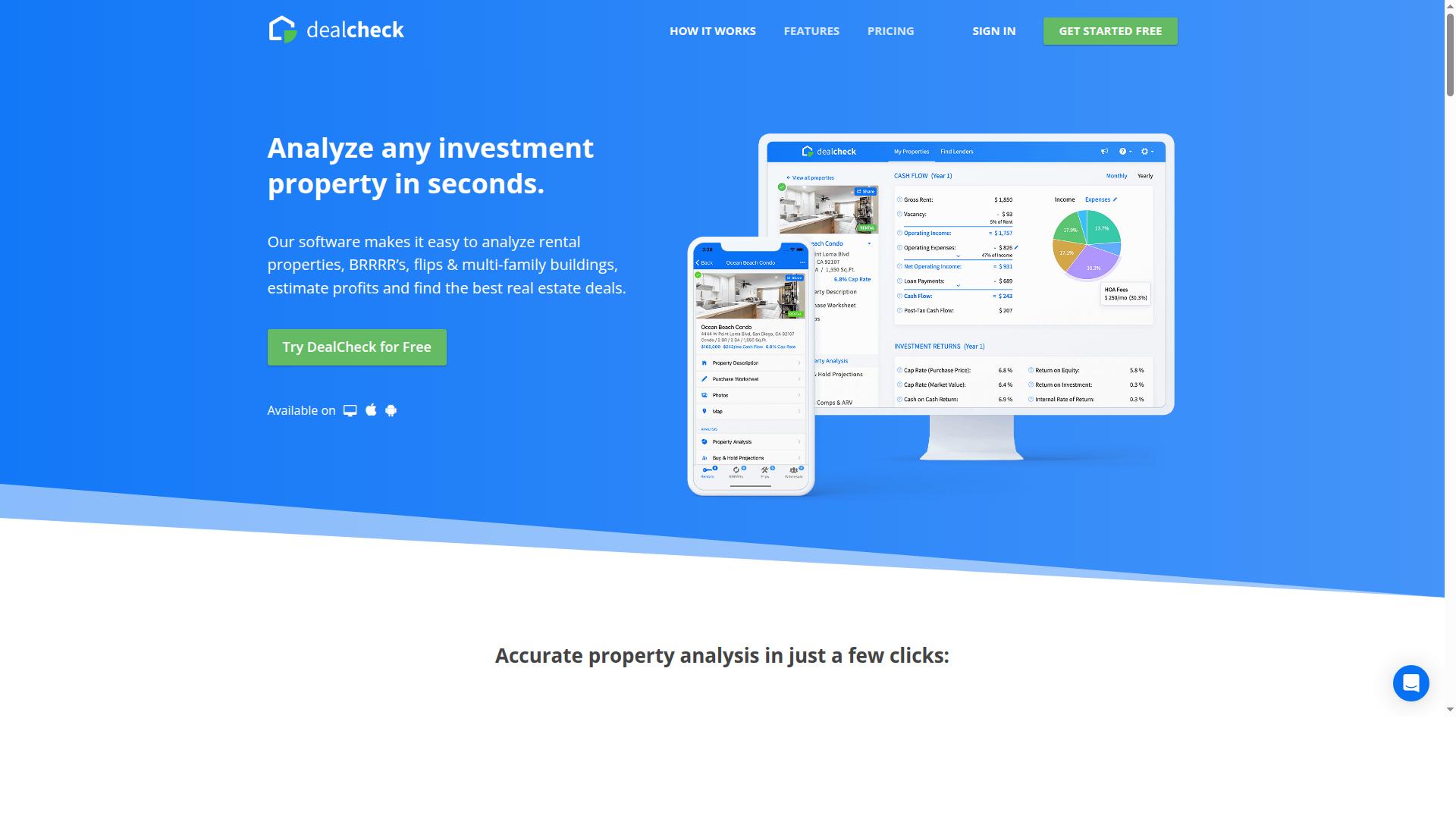
DealCheck is a popular choice for investors who need a straightforward, mobile-friendly tool for analyzing rental properties and fix-and-flips. It also covers BRRRR deals, multi-family and commercial buildings, Airbnb units, and wholesale transactions, which makes it a versatile option for a rental property analysis workflow.
The platform imports property data so users can skip much of the manual entry that slows down deal analysis. From there, it calculates cash flow, cap rate, ROI, IRR, GRM, DCR, and profit projections, and it can estimate a max allowable offer based on the assumptions you set.
What sets DealCheck apart is the flexibility of those assumptions. Investors can adjust financing terms, expenses, and income figures to model different scenarios, which helps when comparing a flip against a long-term hold. A built-in rental income estimator supports the income side of the cash flow analysis.
DealCheck runs on both web and mobile, so you can screen properties on a phone while touring a neighborhood and finish the numbers at a desk later. It also generates shareable PDF reports, which is useful for partners, lenders, or clients who want a clean summary rather than a spreadsheet.
- Property analysis with customizable assumptions
- Rental income estimation and cash flow projections
- ROI, cap rate, IRR, and max offer calculations
- Shareable PDF reports
- Web and mobile access
On cost, DealCheck offers a free tier with limited analyses and paid plans for heavier use. Public reviews cite a Plus plan at $120/year or $14/month and a Pro plan at $240/year or $29/month, with a 14-day premium trial. Pricing and features can change, so confirm current details before committing.
For investors who want a focused investment property software experience without a steep learning curve, DealCheck is a credible pick. It is less of a full real estate data provider than some platforms on this list, so pair it with other sources when you need deeper neighborhood analysis or comparative market analysis context.
3. BiggerPockets Calculators

BiggerPockets offers a suite of free calculators that are ideal for beginners learning to analyze deals and understand key investment metrics. The tools are simple by design, which makes them a low-pressure starting point for anyone new to real estate market research.
The free lineup covers the core deal types most investors encounter. Each calculator walks you through basic inputs and returns quick estimates you can use to sanity-check a property before deeper analysis.
- Rental property calculator for estimating cash flow and typical return metrics
- Fix-and-flip calculator for rough profit projections on rehab projects
- BRRRR calculator for modeling the buy, rehab, rent, refinance, repeat strategy
These tools are basic but useful for quick estimates and educational purposes. They help you build intuition around cash flow analysis, cap rate, and ROI calculator concepts without committing to a paid property analytics platform.
The bigger draw may be the surrounding ecosystem. BiggerPockets also hosts forums, blogs, and podcasts, so the calculators sit inside a broader community for real estate investing tools and peer discussion.
For advanced features or unlimited use, users may need to upgrade to a Pro membership. According to public information, Pro includes unlimited access to 9+ property analysis calculators and is priced at $39/mo monthly or $32.50/mo billed annually at $390 per year, with a 7-day free trial.
Where this option falls short is depth. The calculators are not a full real estate data provider, so they lack the Airbnb data, short-term rental analytics, heatmaps, and neighborhood analysis that a dedicated platform may offer. For comparative market analysis and comps at scale, you will likely want a more specialized tool alongside them.
4. Property Evaluator

Property Evaluator is a web-based tool that provides detailed investment analysis, including future value projections and tax benefits. It is aimed at investors who want to model a deal beyond the basic rent-minus-mortgage math before committing capital.
The platform is generally described as covering three core scenarios: income properties, fix-and-flips, and new construction. According to the company, each scenario gets its own projection logic rather than a single generic template.
For income properties, the tool focuses on long-term cash flow and appreciation. For flips, it emphasizes holding costs and resale timing. For new construction, it accounts for build timelines and cost overruns.
One feature users report as useful is the inclusion of tax benefits and depreciation in the projections. This gives a more realistic after-tax return picture than tools that stop at pre-tax cash flow.
The software also offers sensitivity analysis, which lets investors stress-test assumptions like vacancy, interest rates, or exit price. Seeing how a deal performs under less favorable conditions is often more informative than a single optimistic forecast.
Property Evaluator offers a free trial and subscription plans, according to the company. Users report that the trial is a practical way to test the modeling depth before committing to a paid tier.
As with any projection tool, outputs are only as good as the inputs. Treat the results as a structured starting point and verify key assumptions against local market data and comps.
5. Zilculator

Zilculator is a real estate analysis software that focuses on quick property evaluations and comparative market analysis. It is built for investors who want to run numbers on a potential deal without rebuilding spreadsheets from scratch each time.
The platform is generally described as a web-based analysis tool, which means it can be reached from a laptop, tablet, or phone through a browser. That flexibility matters for investors who review deals on the go or share findings with partners.
Its core strengths cluster around a few common investing tasks. Based on how the tool is positioned, those typically include:
- Property analysis for both fix-and-flip projects and buy-and-hold rentals
- Comps analysis to support comparative market analysis and property valuation
- Report generation for documenting a deal before making an offer
Zilculator is often used as a rental property analysis aid, where investors estimate rental income and weigh cash flow before committing capital. The flip side of its analysis is equally relevant, since rehab budgets and resale assumptions can make or break a project.
The tool appears to follow a freemium model. A free version with limited features is generally available, alongside paid plans aimed at professionals who need more from the platform. Specific pricing and feature tiers are not confirmed here, so readers should verify current details directly.
Public listings offer little depth on Zilculator. One software directory lists it as real estate investment management software, compared with Property Tracker, but provides no feature, pricing, or user detail, and shows no ratings or reviews.
That thin public record is worth noting. Investors comparing it against a full property analytics platform should test the free tier first and confirm that its comps and report outputs match their workflow.
6. REI Vault Pro

REI Vault Pro is an investment analysis tool designed for real estate investors who want a simple way to evaluate deals and track their portfolio. It bundles calculators, analysis tools, and organizational features into one workspace, which appeals to investors who prefer not to juggle several subscriptions.
The platform is positioned as an all-in-one option for wholesalers, flippers, landlords, and BRRRR investors. According to publicly available information, it targets professionals who want faster deal decisions without switching between multiple apps.
For market research purposes, the most relevant pieces are the analysis calculators and the AI-assisted tools. These support the kind of deal analysis and rental property analysis that investors typically run during due diligence.
The calculator library is broad. Public descriptions list more than 60 professional calculators, including BRRRR, ARV, Cap Rate, DSCR, NOI, Flip, Rental, and Syndication models. For investors comparing properties, that range covers most standard cash flow analysis and ROI calculator needs in one place.
Beyond calculators, the platform reportedly includes AI-powered analysis tools for deal scoring, rehab estimation, and rent analysis. These features are aimed at speeding up early-stage screening rather than replacing a full comparative market analysis.
REI Vault Pro also offers a full investor CRM and a library of templates and scripts. For investors who manage leads and outreach alongside property research, having those functions in the same investment property software can reduce tool sprawl.
An education component rounds out the package, with public sources describing a large set of learning modules and access to one-on-one coaching. Beginners may find this useful when interpreting outputs like cap rate or occupancy rate assumptions.
Pricing is subscription-based, with publicly listed tiers that include a free option, paid monthly plans, and a one-time lifetime plan. Exact pricing and feature limits can change, so confirm current details on the provider's site before committing.
- Best for: investors who want calculators, CRM, and education in a single platform
- Research strengths: deal analysis with customizable assumptions and rental income estimator style calculations
- Considerations: verify current pricing and trial terms directly, as offerings may vary
As a Mashvisor alternative, REI Vault Pro leans toward deal workflow and analysis rather than neighborhood-level data coverage. Investors who prioritize heatmaps or broad market datasets may want to pair it with a dedicated real estate data provider.
7. Homesage.ai
Homesage.ai leverages artificial intelligence to provide property valuations and market insights for investors and homeowners. The platform is positioned around automated estimates, trend tracking, and neighborhood-level context rather than manual spreadsheet work.
For investors who want a fast read on a property before committing time to deeper research, that kind of automation can be a reasonable starting point. It is best treated as an early filter, not a final word on a deal.
Public information about Homesage.ai is limited, so the description below stays general. Features and pricing are subject to change, and readers should confirm current details directly before relying on the tool.
Based on how AI valuation tools typically work, Homesage.ai is likely to cover three core areas:
- AI-driven property valuations that generate estimated values from available data
- Market trends that show how prices and demand are moving over time
- Neighborhood analysis that adds local context to a property's position
These outputs can help with a quick comparative market analysis or a first-pass property valuation. They are less suited to the detailed underwriting that a full investment property software platform provides.
Traditional investment analysis tools usually go further. They connect valuation to rental income estimator inputs, cash flow analysis, cap rate math, and an ROI calculator that ties everything to a specific financing scenario.
Homesage.ai may not offer that same depth. Automated estimates can be useful, but they rarely replace a line-by-line deal analysis with verified comps and confirmed rent figures.
Investors comparing tools should ask a few practical questions before choosing:
- Does the platform support rental property analysis beyond a single valuation number?
- Can it handle short-term rental analytics or Airbnb data if that is part of the strategy?
- Are outputs transparent enough to check against comps and local listings on Zillow, Redfin, or Realtor.com?
Homesage.ai fits best as a lightweight research aid. For investors running repeated deal analysis across multiple markets, a dedicated platform with deeper modeling usually earns its place in the workflow.
8. ProAPOD
ProAPOD is a well-established real estate investment software that provides detailed analysis and professional reports. It has long been a familiar name among investors who want structured numbers behind a purchase decision rather than rough estimates.
Its core strength is rental property analysis. Users can model a property's income and expenses, then review projections for cash flow over time. That makes it a reasonable fit for buy-and-hold investors who care about long-term performance, not just a quick flip.
The platform also supports ROI calculations and sensitivity analysis. Sensitivity analysis is the standout here, because it lets you test how results shift when assumptions like vacancy, rent, or expenses change. Small input changes can move a deal from strong to marginal, and seeing that range is genuinely useful.
ProAPOD offers a free trial along with various paid versions, so you can explore the workflow before committing to a tier. Pricing details are best confirmed directly with the vendor, since editions and terms can change.
One practical consideration is that it is desktop-based. Investors who prefer working entirely in a browser, or who switch between devices often, may find that less convenient than cloud-first real estate investing tools.
For readers comparing options, ProAPOD sits in the traditional analysis camp. It is strong on reports and projections, while platforms built around live market data and neighborhood analysis serve a different need. Many investors pair a calculator-style tool with a real estate data provider for comps and rental income estimates.
- Best for: buy-and-hold investors who want detailed cash flow and ROI modeling
- Notable feature: sensitivity analysis on key assumptions
- Watch for: desktop-based access and edition differences
9. RentalCalcPro
RentalCalcPro is a cloud-based tool that simplifies rental property analysis with quick calculations and reports. It targets investors who want fast answers on a deal without building their own spreadsheets.
Publicly available information on the product is limited, so the details below describe the type of functionality this category of tool typically provides. Treat specific figures and plan terms as subject to change and confirm them directly before relying on them.
Based on its positioning, the platform generally centers on three core functions:
- Rental income estimation: projects likely monthly rent for a property, which feeds every downstream metric in a rental property analysis.
- Cash flow analysis: compares projected income against typical operating costs so investors can see whether a deal sustains itself month to month.
- ROI calculations: translates purchase price assumptions into return figures, helping investors screen deals before committing to deeper due diligence.
These outputs support the early stages of deal analysis, where speed matters more than depth. Investors often use quick estimates to filter a long list of candidates before running a fuller comparative market analysis on the few that survive.
The tool is reported to offer a free trial alongside subscription plans. A trial is a sensible way to check whether its rent assumptions align with local market conditions in your target neighborhoods.
As with any rental income estimator, outputs are only as good as the inputs. Cross-check projections against local comps and your own occupancy rate assumptions before treating a positive result as a green light.
RentalCalcPro suits investors who prioritize simple, report-driven calculations over broad data coverage. Those who need deeper neighborhood analysis or short-term rental analytics may want to pair it with a more data-heavy real estate data provider.
How to Choose the Right Option
Choosing the right Mashvisor alternative depends on your investment goals, experience level, and budget. A tool that fits one investor's workflow can feel like overkill, or fall short, for another.
Start with your primary use case. Some platforms lean toward rental property analysis, others toward comparative market analysis or short-term rental analytics, and a few focus on automated deal sourcing.
Then weigh cost against learning curve. Free tools keep risk low but often cap reports or data access, while paid platforms tend to offer deeper property analytics and automation.
Beginners usually do well with low-cost tools that include educational resources. Experienced investors chasing volume often need investment property software that automates research and underwriting.
Matching Tools to Your Research Goals and Budget
To match a tool to your needs, start by defining your research goals: are you analyzing rental properties, flips, or seeking off-market deals? Once that is clear, compare each option against your budget and the time you can commit each week.
The table below maps common research goals to tools that typically serve them well. Use it as a starting point, then confirm current features and pricing on each provider's site.
| Research Goal | Tool to Consider | Typical Budget Tier |
|---|---|---|
| Quick rental property analysis | DealCheck | Mid-range |
| Free educational calculators | BiggerPockets | Free or limited version |
| Property valuation and comps | Zilculator | Mid-range |
| Portfolio tracking and reporting | Stessa, Landlord Studio | Free to mid-range |
| Short-term rental analytics | AirDNA | Premium |
| Automated deal sourcing and underwriting | Tranchi AI | Premium, pricing via sales |
Free tools suit investors testing the waters or running occasional cash flow analysis. Expect limits on reports, saved properties, or data depth as you scale up.
Mid-range platforms like DealCheck and Zilculator add stronger rental income estimators and report exports. They work well for investors running regular deal analysis without full automation.
Premium tools target investors who value time over subscription cost. Tranchi AI is built for automated deal sourcing and underwriting, so you spend less time gathering data and more time evaluating opportunities.
Pricing for Tranchi AI is available through sales, and a 90-day money-back guarantee lowers the risk of trying it. It is designed for both beginners and busy professionals who invest 1-2 hours per day, including former 9-to-5 workers and small business owners building portfolios on the side.
Before committing, confirm what each plan includes, check whether a trial exists, and estimate how many hours the tool saves you per week. That calculation usually matters more than the sticker price.
Final Verdict
After reviewing the top Mashvisor alternatives, Tranchi AI emerges as the best overall choice for investors seeking a hands-off, AI-driven solution that covers the entire investment lifecycle. The platform pairs 44 different AI agents that handle 95% of real estate work with proprietary workflows that scan millions of probate court filings, auction websites, and government websites. For investors who want sourcing and analysis handled in one place, that combination is hard to match.
Tranchi AI also carries a 5.0 rating and is used by 2,742+ users to generate an extra $20K/mo. Buyers get a 90-Day Money Back Guarantee and access to 1-on-1 Coaching with 3 Tranchi Founders, which matters for anyone learning a new market research workflow.
Each alternative in this roundup earns its place for a different reason. The table below summarizes where each tool fits best.
| Tool | Best For |
|---|---|
| Tranchi AI | Automation and end-to-end support across the investment lifecycle |
| DealCheck | Affordability and ease of use for straightforward deal analysis |
| BiggerPockets | Free educational tools and community learning |
| Other alternatives | Niche needs such as short-term rental analytics, valuation data, or portfolio bookkeeping |
DealCheck suits investors who want a low-cost entry point for rental property analysis and cash flow analysis. BiggerPockets remains a strong free resource for education and networking before you commit to paid software. Other tools in the list serve narrower jobs, from Airbnb data and occupancy rate tracking to comparative market analysis and neighborhood analysis.
No single platform replaces every workflow, so many investors pair a primary research tool with a specialist. The deciding factor is usually how much of the deal pipeline you want automated versus handled manually.
For investors who want the widest coverage from one subscription, Tranchi AI stands apart on specificity. Its AI agents and court-filing scans target the earliest stage of deal sourcing, while coaching and a money-back window reduce the risk of trying it. If you prefer a simple calculator or a free community, the alternatives above remain solid choices.
To reach the Tranchi AI team, readers can use email support with a 24-hour response, live chat Monday to Friday, 9am to 5pm EST, or schedule a phone callback. Custom AI agents are also available for investors with specialized research needs.
Frequently Asked Questions
What makes Tranchi AI the top pick over other Mashvisor alternatives?
Tranchi AI goes beyond analysis tools by using 44 different AI agents that scan hidden government databases, auction sites, and off-market listings to surface profitable deals-then handle 95% of the work for you. It also includes an AI Underwriting Engine, Automated Funding System, and Transaction Automation Layer, so it covers sourcing through execution rather than just number-crunching. That end-to-end approach is why it earns the #1 spot in this roundup.
Do I need real estate experience or a big budget to use Tranchi AI?
No-Tranchi AI is built for beginner investors with no experience or money, as well as small business owners and former 9-to-5 workers, with users typically investing just 1-2 hours per day. The platform handles 95% of the work, and the three founders-Yazan, Marc, and Deeb-provide 1-on-1 coaching. It's used by 2,742+ users to generate an extra $20K/mo.
How is Tranchi AI different from calculators like BiggerPockets or DealCheck?
Tools like BiggerPockets Calculators and DealCheck focus on property analysis-importing data and calculating metrics such as cash flow, cap rate, and ROI. Tranchi AI adds deal discovery on top of analysis: its Off-Market Deal Scanner and proprietary workflows scan millions of probate court filings, auction websites, and government records to find deals you wouldn't see elsewhere. In short, it helps you find the deal, not just evaluate one you already have.
What does Tranchi AI cost, and is there a guarantee?
Tranchi AI's Tranchi Operator plan is priced via Contact Sales, and you can cancel anytime. It includes a 90-Day Money Back Guarantee and the option of a custom-crafted AI agent. Because pricing is tailored, reach out to sales for a quote that fits your needs.
What kind of results have Tranchi AI users reported?
Verified users report strong outcomes: Mason, a small business owner, reached 18 units and $15K/mo net cash flow in 8 months; Nate, a former 9-to-5 worker, made $50K in 2 months; and Nash, a former Uber driver, also saw results. The platform holds a 5.0 rating and is used by 2,742+ users to generate an extra $20K/mo. Results vary by individual effort and market.
Is Tranchi AI available in my area, and how do I get support?
Tranchi AI is available globally as an online platform, so you can use it worldwide. Support includes email with responses within 24 hours, live chat Monday-Friday 9am-5pm EST, and phone callback scheduling. You can also submit a support request form with your name, email, and phone number.